Porlock
Beneath Exmoor's steepest hill, where moor meets marsh and sea
Photo © David Smee, Google Maps
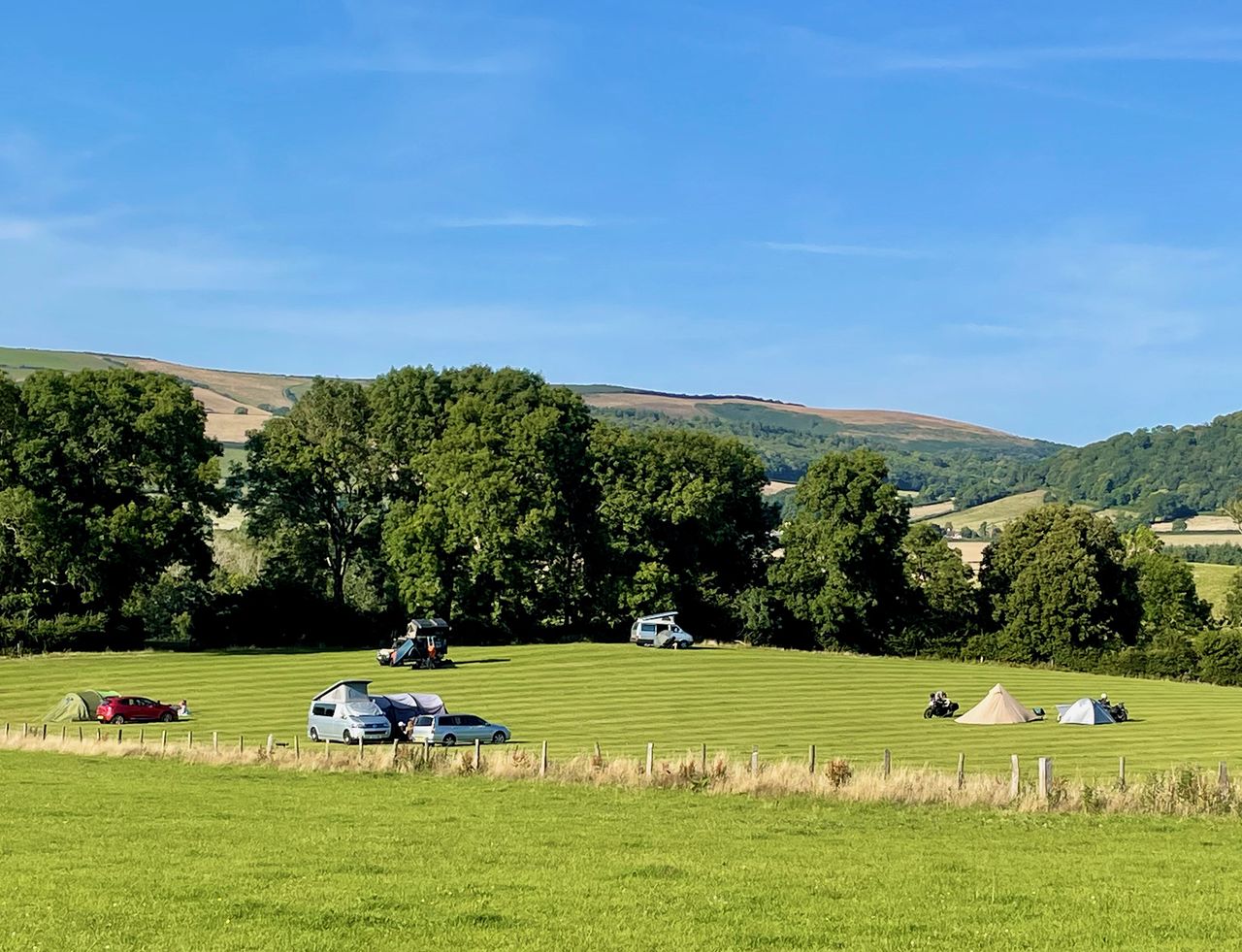
Porlock sits at the western end of its own broad vale, wedged between a shingle storm ridge on the Bristol Channel and the high moorland wall of Exmoor National Park that rises abruptly behind it. The village itself is a huddle of thatched and colour-washed cottages along a High Street that has changed little in character for centuries, with the 13th-century tower of St Dubricius' church still marking its centre. It has long attracted writers and walkers: Robert Southey called it "the finest spot on the British Channel", and Samuel Taylor Coleridge stayed nearby while composing "Kubla Khan" in 1797, only for the poem to be cut short by an unnamed visitor later immortalised as the "person from Porlock".
Two miles to the west, down a flat stretch of the vale, the tiny tidal harbour of Porlock Weir gives the area its second, quite different character: fishing boats and dinghies resting on shingle at low tide, a cluster of thatched buildings around the lock gates, and the Porlock Marsh saltmarsh and shingle ridge, a Site of Special Scientific Interest, stretching along the shore. Between the village and the sea, and up onto the moor behind, Porlock rewards slow exploration on foot as much as by car.
Top things to do in Porlock
Porlock and its Weir pack in a surprising range of things to do for such a small place, from steep drives to quiet coastal walks.
- Porlock Hill — the notoriously steep A39 climbs out of the village at gradients reaching 1 in 4 (25%), officially the steepest stretch of any A-road in Britain, with hairpin bends and, near the top, sweeping views back over the vale and Bristol Channel; a gentler toll road offers an alternative 1-in-14 route up the hill.
- Porlock Weir — a working tidal harbour and a favourite spot to watch boats come and go, browse craft shops, or sit outside with an ice cream over the water.
- Exmoor National Park — Porlock is one of the best-placed bases for exploring Exmoor's high heather moorland, oak woodland combes and free-roaming Exmoor ponies, much of it accessible directly from the village on foot.
- Culbone Church — reached only by a wooded coastal path from Porlock Weir, this tiny Saxon-founded church, dedicated to St Beuno, is reckoned to be the smallest complete parish church in England.
- Doone Valley — the wild valley of Badgworthy Water near Oare, setting for R.D. Blackmore's novel "Lorna Doone", lies a short drive south-west and makes for one of Exmoor's best-loved walks.
- Dovery Manor Museum — a volunteer-run local museum in a 15th-century manor house on Porlock High Street, covering the village's history, its literary visitors and rural life on Exmoor.
- Coleridge's "Kubla Khan" trail — walkers can follow the wooded coast path towards Culbone that Coleridge is said to have taken, tracing the landscape linked to one of English poetry's most famous unfinished works.
Getting to Porlock
Porlock sits on the A39 coast road in West Somerset, roughly 6 miles west of Minehead and around 10 miles east of Lynmouth in North Devon, with the notorious Porlock Hill forming the boundary between the two. By car it is about 45 minutes from Taunton and the M5, via the A358 and A39. The nearest mainline railway station is Taunton, from where local bus services run towards Minehead and on to Porlock; the heritage West Somerset Railway also runs seasonally as far as Minehead, a short onward bus or taxi ride away. There is no station in Porlock itself, so a car remains the easiest way to explore the surrounding villages, moor roads and coast path car parks.
Best time to visit Porlock
Late spring and early summer bring gorse and bluebells to the surrounding combes and long daylight for walking on Exmoor, while September and October colour the oak woodland around Culbone and Horner and thin out the summer crowds on Porlock Hill. High summer is busiest, especially around Porlock Weir's harbour, but the shingle ridge and marsh stay quieter than the village centre even in peak season. Winter has its own appeal for storm-watching from the shingle ridge and for cosy fireside pubs, though some seasonal shops and cafes reduce their hours, and Porlock Hill can be closed in snow or ice, in which case traffic is diverted onto the toll road.
Where to stay in Porlock
Accommodation in Porlock ranges from characterful old coaching inns on the High Street to seaside hotels at Porlock Weir and self-catering cottages scattered through the vale and surrounding hamlets. Staying in the village puts you within walking distance of the shops, church and Dovery Manor Museum, while a base at Porlock Weir suits those who want harbour views and easy access to the coast path towards Culbone. Further out, farm cottages and B&Bs around Doverhay, Bossington and Allerford offer a quieter, more rural stay with Exmoor's moorland on the doorstep.
Food and drink in Porlock
The Ship Inn on Porlock High Street is a former 13th-century coaching inn, one of the oldest on Exmoor, serving food throughout the week beside its log fires. Down at the harbour, a second Ship Inn — known locally as the "Bottom Ship" — is a thatched, 200-year-old pub with rooms and a restaurant menu. Also at the Weir, Locanda at the Weir serves an à la carte menu blending Exmoor produce with Mediterranean flavours, while the Porlock Weir Hotel's waterfront restaurant offers locally sourced food and wood-fired pizza daily. Back in the village, the Royal Oak is a traditional dog-friendly pub on the High Street, and Porlock's shops sell locally made jams, cheeses, fudge and other Somerset produce.